
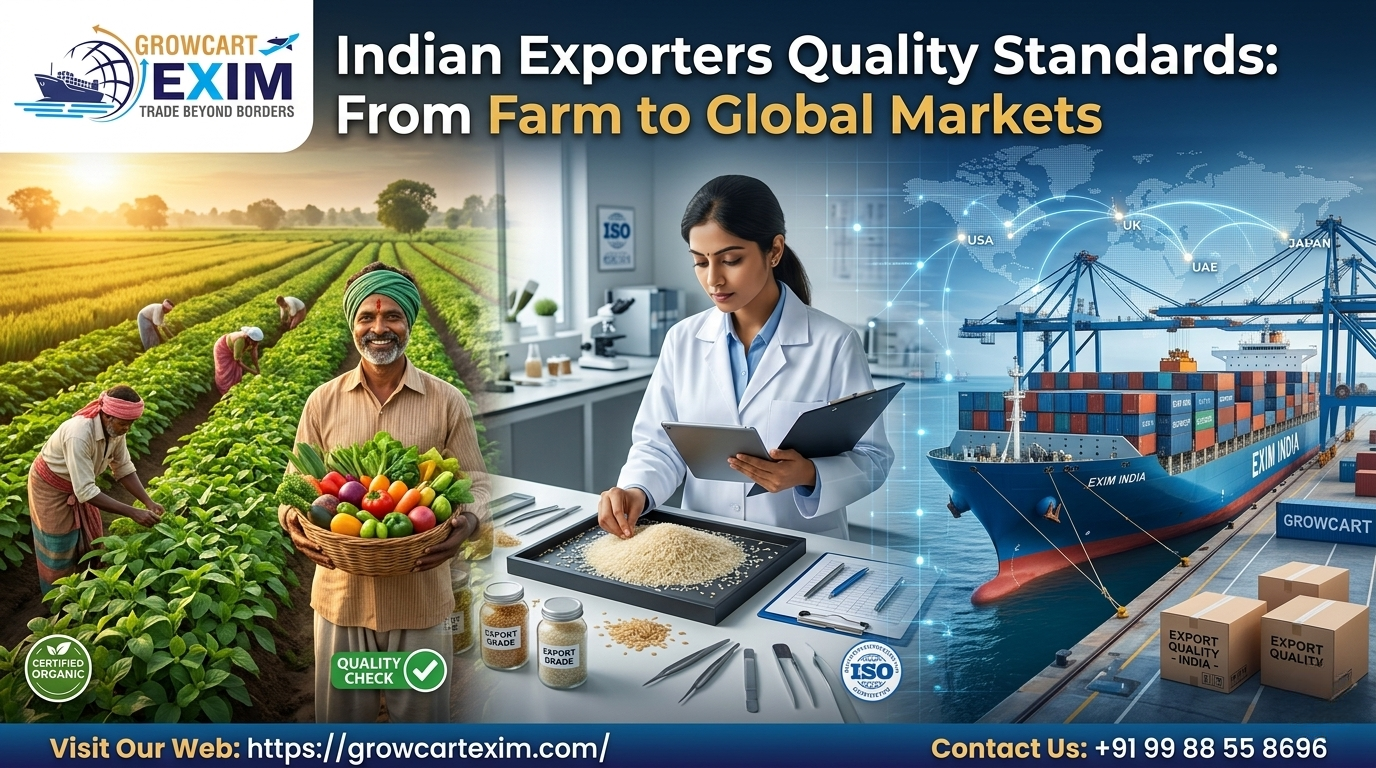
Indian Exporters Quality Standards
In the world of international trade, quality is not just a selling point; it is a fundamental requirement. As global buyers grow increasingly discerning about what they import, Indian exporters have risen to meet the challenge with robust systems, credible certifications, and meticulous farm-to-market processes. Whether you are a wholesale buyer in Europe, a distributor in the Middle East, or a food brand sourcing from Asia, understanding Indian Exporters' Quality Standards is essential before you sign any contract.
India is among the world's top agricultural exporters, shipping everything from spices and pulses to fresh produce, sesame seeds, and organic grains to over 150 countries. Behind this massive trade volume lies a rigorous quality assurance architecture that begins at the farm level and extends all the way to the container reaching your port. This guide breaks down exactly how Indian Exporters Quality Standards work, what certifications matter, and how leading companies like Grow Cart Exim ensure that every shipment meets and often exceeds international benchmarks.
What Are Export Quality Standards?
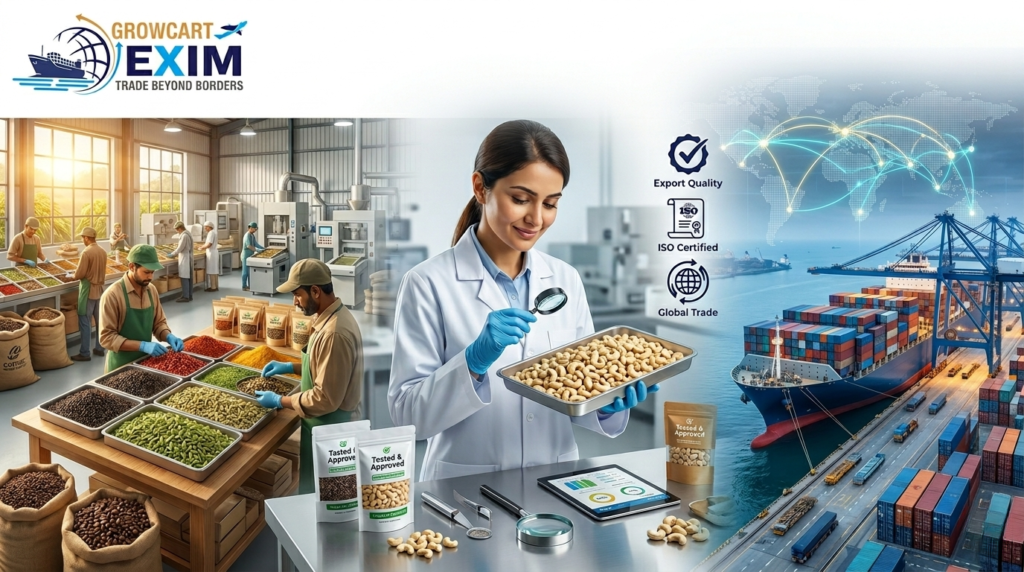
Export quality standards are a set of defined criteria that products must meet before they can be legally shipped across international borders. These standards cover several dimensions of product integrity, including safety, composition, labeling, packaging, and traceability. For agricultural and food products, these requirements are especially stringent because they directly affect human health.
In the Indian context, export quality standards are governed by multiple regulatory bodies, each responsible for a different aspect of trade compliance. These include physical and chemical quality parameters, microbiological limits, pesticide residue thresholds, moisture content restrictions, and country of origin documentation.
The key areas covered under export quality standards include:
- Physical standards — size, color, shape, foreign matter limits, and defect thresholds
- Chemical and nutritional standards — moisture, protein, fat, and mineral content
- Microbiological safety — limits on bacteria, fungi, molds, and pathogens
- Pesticide residue limits — maximum residue levels as per importing country regulations
- Packaging and labeling — product identity, weight, batch codes, and country of origin
- Traceability — the ability to trace a product back to its farm, processing unit, and shipment date
Why Quality Standards Matter in Global Markets
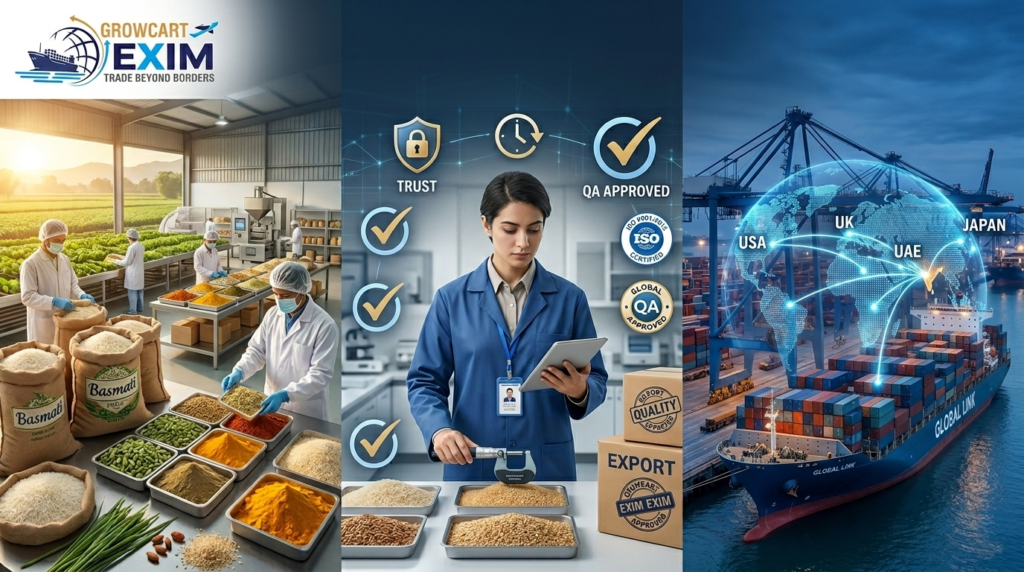
The stakes of non-compliance in international trade are extremely high. A single shipment rejected at a foreign port can result in financial losses, reputational damage, and even a permanent blacklist from certain import markets. This is why understanding international export quality requirements is non-negotiable for any serious exporter.
From the importer's perspective, quality standards assure that the product will perform as described, that the spices are free of contamination, that the grains meet declared protein content, and that the packaging is intact and properly labeled. For regulators in importing countries, whether the EU, USFDA, or CFIA, these standards exist to protect consumers.
When you source from an exporter who follows verified Indian Exporters Quality Standards, you are not just buying a commodity; you are buying a quality system. The result is fewer surprises at customs, more consistent product performance, and a stronger long-term partnership.
Here is why quality standards matter for buyers:
- Rejected shipments cost importers both the product value and freight charges
- Consistent quality builds brand equity for retailers and food manufacturers
- Regulatory compliance protects buyers from legal liability in their own markets
- Documented quality systems make supply chains more transparent and trustworthy
- Certified suppliers face lower customs scrutiny, ensuring faster port clearance
How Indian Exporters Maintain Quality at Every Stage
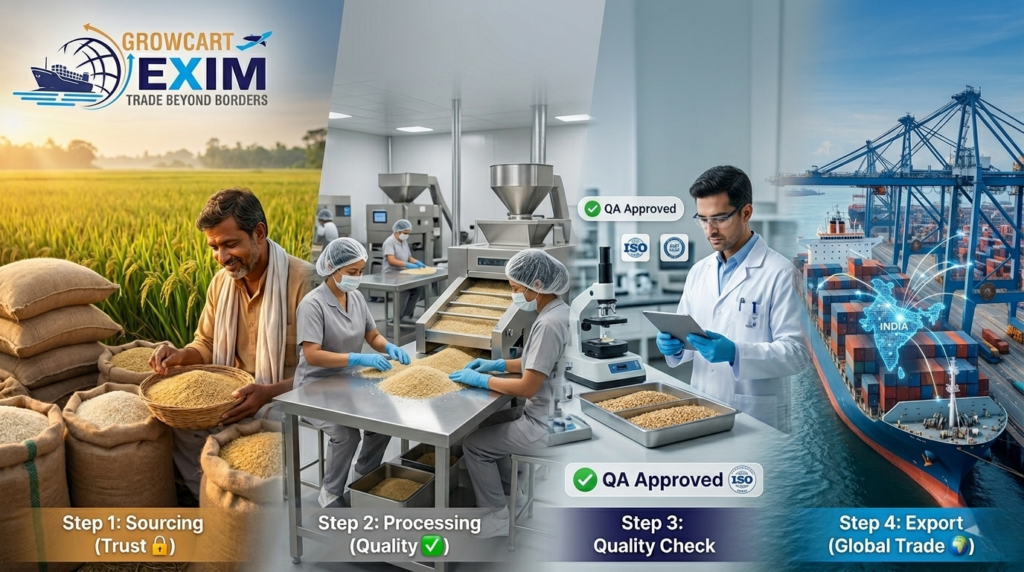
The farm-to-export supply chain in India involves multiple checkpoints, each with its own quality control mechanism. Understanding this process helps importers appreciate the depth of effort that goes into ensuring product integrity.
1. At the Farm Level — Good Agricultural Practices (GAP)
Quality assurance begins at the source. Responsible Indian exporters work only with farms that follow Good Agricultural Practices (GAP), a framework that regulates soil health, irrigation quality, use of pesticides and fertilizers, harvesting methods, and post-harvest handling. GAP certified farms maintain field records, use approved inputs, and undergo third-party audits.
- Farmers are trained on safe pesticide use and residue management
- Irrigation water is tested for contamination
- Harvesting tools and storage containers are sanitized regularly
- Field to storage traceability documentation is maintained at every step
2. At the Processing Stage Quality Control for Export Products
Once harvested, products enter certified processing units, where rigorous quality control for export is applied. Processing includes cleaning, sorting, grading, and value adding all under hygienic conditions that meet HACCP protocols.
- Multi-stage cleaning removes soil, dust, stones, and foreign material
- Electronic color sorters and optical graders ensure visual uniformity
- Metal detectors screen for any contamination at packaging lines
- Batch-wise laboratory testing is done for moisture, purity, and microbial load
- In-house and third-party labs verify compliance with buyer specifications
3. Export Inspection Process in India
Before shipment, products undergo the formal export inspection process in India. This involves pre-shipment inspection by bodies like the Export Inspection Council (EIC) or accredited third-party agencies. Inspectors verify product quality, quantity, packaging, labeling, and documentation to ensure everything aligns with the purchase contract and the destination country's regulations.
- Random sampling of consignments at the warehouse or port
- Lab analysis reports cross-checked against buyer specifications
- Certificate of Inspection issued to accompany the shipment
- Phytosanitary certificates issued by the Plant Quarantine authorities
Certifications and Compliance in India
One of the most distinguishing features of Indian Exporters Quality Standards is the comprehensive certification landscape. These certifications validate that an exporter's processes, products, and facilities meet globally recognized benchmarks. For international buyers, sourcing from certified exporters significantly reduces risk.
The export certification process in India involves applying to relevant authorities, passing facility audits, meeting technical standards, and maintaining ongoing compliance through annual renewals and audits. Here are the key certifications that matter:
FSSAI — Food Safety and Standards Authority of India (FSSAI). Mandatory for all food product exporters. Ensures products meet Indian food safety regulations before they leave the country.
APEDA — Agricultural and Processed Food Products Export Development Authority. Required for agricultural exports. Provides market development support and export certification for a wide range of agri-commodities.
ISO 22000 — An international food safety management standard. It demonstrates a systematic approach to controlling food safety hazards across the entire supply chain.
Organic Certification (NOP / EU Organic) — USDA NOP for the US market and EU 2018/848 for European buyers. Third-party certified to ensure compliance with organic farming practices and permissible input standards.
HACCP — Hazard Analysis and Critical Control Points. A science-based food safety management system that identifies and controls biological, chemical, and physical hazards in food production.
GMP / GHP — Good Manufacturing Practices and Good Hygiene Practices. Covers facility sanitation, personnel hygiene, equipment maintenance, and documented standard operating procedures in processing units.
In addition to product certifications, Indian export compliance guidelines require exporters to maintain proper documentation, including commercial invoices, certificates of origin, packing lists, bills of lading, phytosanitary certificates, and fumigation certificates where applicable. Every document is part of the compliance chain that protects both the buyer and the seller.
Packaging, Storage, and Logistics Best Practices
A product that passes all quality tests can still fail at the final mile if packaging and logistics are poorly managed. Export packaging standards in India are guided by both international requirements and destination country regulations. Packaging must be food grade, durable enough for long-haul transit, and compliant with the labeling laws of the importing country.
Packaging Standards for International Markets
- Food-grade primary packaging, such as LDPE bags, PP woven sacks, or Kraft paper, that prevents moisture ingress
- Outer cartons are tested for compression strength and stacking loads during ocean freight
- Labels printed in the language of the destination country with all mandatory disclosures
- Batch numbers and production dates are stamped on every unit for full traceability
- Vacuum-sealed or nitrogen-flushed packaging for oxygen-sensitive products
- Compliance with ISPM 15 standards for wooden pallets to prevent pest transmission
Storage and Cold Chain Management
- Temperature and humidity-controlled warehouses for moisture-sensitive commodities
- First In First Out (FIFO) stock rotation to ensure freshness
- Regular pest control and fumigation logs are maintained for compliance audits
- Reefer containers are used for perishable or temperature-sensitive exports
Logistics and Shipment Reliability
- Container stuffing is done under qualified supervision to prevent damage and contamination
- Desiccants are placed inside containers to absorb moisture during transit
- GPS tracked shipments for real-time visibility and accountability
- Pre-shipment samples are retained for reference in case of quality disputes
How Grow Cart Exim Ensures Consistent Global Quality
At Grow Cart Exim, quality assurance in export business is not a department; it is a company-wide culture. Every product that leaves our facility has passed through a multi-stage quality chain that begins with farmer selection and ends with port of destination verification. Our approach to Indian Exporters Quality Standards is built on four pillars: source integrity, process rigour, certification transparency, and customer partnership.
Here is how we deliver consistent quality to our global buyers:
- Farmer Partnerships — We work directly with GAP-certified and organically transitioning farms, providing training, inputs, and traceability tools to ensure quality starts at the root
- In-House Lab Testing — Every batch undergoes internal quality testing for moisture, purity, foreign matter, and microbiological parameters before third-party verification
- Multi Certification Compliance — We are registered with APEDA and FSSAI, and our products are available with NOP Organic, EU Organic, ISO 22000, and HACCP certifications based on market requirements
- Buyer Specific Customization — We adapt our packaging, labeling, and documentation to match the regulations of each destination country, whether the EU, US, Middle East, or Southeast Asia
- Pre-Shipment Inspection — Every consignment is inspected by an accredited third-party agency, with full test reports shared with the buyer before loading
- End-to-End Traceability — Our traceability system allows buyers to trace any lot back to its origin farm, processing date, and testing batch, supporting full supply chain transparency
We believe that sustainable export relationships are built on verified quality, honest communication, and consistent delivery. Grow Cart Exim's track record with global importers is a direct result of our commitment to upholding the highest Indian Exporters Quality Standards India has to offer, not just for compliance, but because we believe quality is the foundation of trust.
Conclusion
The global marketplace demands nothing less than verified excellence. As international buyers become more sophisticated and regulatory environments become more demanding, Indian exporters' quality standards have evolved to meet and often exceed these expectations. From GAP-certified farms to FSSAI-registered processing units, from APEDA-approved documentation to ISO certified management systems, India's export quality framework is robust, transparent, and internationally credible.
For importers and wholesalers seeking reliable agricultural and organic products, choosing an Indian exporter who genuinely lives by these standards, not just on paper, but in practice, is the smartest investment you can make in your supply chain. At Grow Cart Exim, we are proud to represent the best of what Indian export compliance guidelines and quality assurance can deliver.
Ready to source with confidence? Partner with Grow Cart Exim today. Contact us to discuss your requirements, request product samples, or download our full product catalogue.
Also Read: Best Basmati Rice Exporters from India: Trusted Suppliers for Global Markets
Frequently Asked Questions
Q1. What are the main quality standards Indian exporters must follow?
Indian exporters must comply with FSSAI food safety regulations, APEDA guidelines for agricultural exports, and destination country-specific standards such as EU pesticide MRLs or USFDA regulations. Physical, chemical, and microbiological parameters are tested at multiple stages. Certifications like ISO 22000, HACCP, and organic certifications provide additional assurance of systematic quality control.
Q2. Which certifications are required for food and agricultural exports from India?
The minimum requirements are FSSAI registration and APEDA registration for agricultural products. Depending on the destination market, exporters may also need NOP Organic or EU Organic certification, ISO 22000 or HACCP for food safety management, and phytosanitary certificates from the Plant Quarantine authority. Proper export documentation compliance is equally critical to meet importing country customs requirements.
Q3. How do Indian exporters ensure product quality before shipment?
Quality assurance in Indian exports typically involves multiple stages of farm-level GAP compliance, in-house processing quality checks, third-party pre-shipment inspection, and laboratory testing for key parameters. Exporters like Grow Cart Exim also maintain lot-wise traceability records so that any quality issue can be traced back to its origin quickly and resolved transparently.
Q4. Why is quality so important in international agricultural trade?
In international trade, non-compliant shipments face rejection at the port of entry, leading to financial loss and regulatory penalties for both the exporter and importer. Beyond compliance, consistent quality builds buyer trust, reduces product returns, and strengthens the brand reputation of everyone in the supply chain. Quality is ultimately the foundation of every long-term trade relationship.
Q5. What role does Grow Cart Exim play in maintaining Indian export quality standards?
Grow Cart Exim is a certified Indian exporter of organic and agricultural products committed to end to end quality assurance. The company works with GAP-certified farms, maintains FSSAI and APEDA registrations, conducts in house and third party lab testing, and customizes packaging and documentation to meet each buyer's country-specific requirements. Every shipment is traceable, compliant, and consistent in quality.

0 Comments