

Imagine turning a single acre of fragrant grain into a six-figure revenue stream that crosses three international borders. That is the reality of the rice export business today.
But here is the problem most new exporters face: They have the rice, but they don’t have the roadmap. They lose money on incorrect documentation, choose the wrong ports, or fail to meet the quality standards of buyers in Saudi Arabia or the UAE.
In this guide, we walk you through the exact basmati rice export process, the profit margins you can expect, and how to tap into the booming international market. Whether you are a farmer, trader, or entrepreneur, this is your step-by-step playbook.
Why Basmati Rice? Understanding the Global Demand
Primary Keyword Integration: The global appetite for basmati rice export has skyrocketed, not just because people need food, but because they demand premium food.
- Global rice trade statistics show that Basmati accounts for nearly 15% of the value of all rice traded, despite being only 1% of the volume.
- Key drivers: The growing Middle Eastern expat population, rising disposable incomes in Europe, and the health trend towards low-glycemic index foods.
Best Countries to Export Basmati Rice (2025 Rankings)
If you are researching the best countries to export basmati rice, focus on these top 5 importers:
| Rank | Country | Why? | Annual Import (Approx.) |
| 1 | Saudi Arabia | Largest buyer; prefers Sella & 1121 variety | 1.2M tons |
| 2 | Iran | High-quality Pusa Basmati; state tenders | 1.0M tons |
| 3 | UAE | Re-export hub (Dubai); Pusa & 1509 | 0.8M tons |
| 4 | Iraq | Growing demand for premium grades | 0.5M tons |
| 5 | USA/UK | Ethnic retail & organic niche | 0.4M tons |
Entity Note: The Middle East rice market is unique because it requires "super kernel" length (over 8.4mm) and specific aging (2+ years) for premium pricing.
The Basmati Rice Export Process (Step-by-Step)
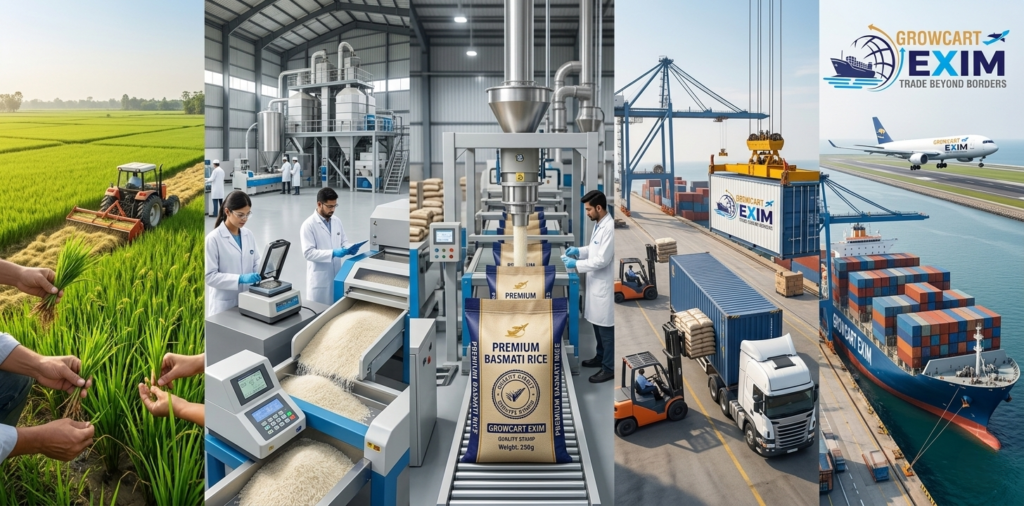
Let us demystify the export procedure for rice business. This is a 6-step process from farm to foreign port.
H2: Step 1 – Sourcing & Quality Control (The Non-Negotiable)
You cannot export any long-grain rice and call it Basmati. Legally, only the varieties grown in specific geographic regions of India and Pakistan (under GI tagging) qualify.
- Entity Check: You must verify the export quality standards for rice set by APEDA (Agricultural and Processed Food Products Export Development Authority).
- Key varieties: 1121 (longest grain), Pusa (aromatic), and 1509 (early crop).
H2: Step 2 – Legal Registration (IEC & GST)
Before you ship a single grain, you need your paperwork. The basmati rice export documentation starts here.
Required Licenses:
- IEC Code (Import Export Code): Issued by DGFT. Without this, customs will reject your consignment.
- GST Registration: Mandatory for claiming input tax credits on packaging and logistics.
- APEDA Registration: You must register as a rice exporter with APEDA to get the Certificate of Origin (essential for the Middle East).
H2: Step 3 – Market Research & Pricing Strategy
How do you set your price? The rice export pricing strategy is dynamic.
- Formula: (Cost of paddy + Milling + Polishing + Packaging + Logistics + Exporter Margin) / Exchange Rate.
- Cost of exporting basmati rice: On average, $850–$1,200 per metric ton (FOB – Free On Board) for premium 1121 variety.
- Pro tip: Use export market research for rice tools like Export Genius or Trademap to see what your competitors are charging.
H2: Step 4 – Packaging & Labeling for Export
This is where beginners fail. Middle Eastern buyers require Arabic labels. European buyers require EU organic certifications.
- Standard packaging: 20kg, 40kg, and 50kg jute or non-woven fabric bags.
- Labeling law: Must state "Basmati Rice," Net Weight, Country of Origin (Product of India), and Importer details.
H2: Step 5 – Logistics & Supply Chain
Rice export logistics and shipping is a game of volume. You will likely use a FCL (Full Container Load).
- Container types: 20ft container holds ~26 metric tons of bagged basmati.
- Ports: Mundra (Gujarat) and Nhava Sheva (Mumbai) are the fastest for Middle East routes.
- Supply chain management in rice export: You need a warehouse near the port to consolidate shipments and avoid detention charges.
H2: Step 6 – Payment & Documentation Handover
Use Letters of Credit (LC) for safety. The final documents you hand to the buyer via the bank include:
- Bill of Lading
- Commercial Invoice
- Packing List
- Certificate of Origin (APEDA)
- Phytosanitary Certificate
Basmati Rice Export Profit Margin (The Real Numbers)
Let us talk money. The basmati rice export profit margin is the #1 commercial question.
Scenario: Exporting 1 Container (26 MT) of 1121 Basmati Sella from India to Dubai.
| Cost Component | Amount (USD) |
| FOB Price (Rice + Milling) | $22,000 |
| Freight (Mundra to Jebel Ali) | $2,500 |
| Insurance & Clearing | $300 |
| Total Landed Cost | $24,800 |
| Selling Price in UAE | $29,000 |
| Gross Profit | $4,200 |
| Profit Margin | ~14.5% |
Key takeaway: The profit in agro export business is not in volume alone; it is in branding. White-labeling your rice for a specific supermarket chain can increase margins to 25%.
Comparison: Basmati vs. Non-Basmati Rice Export
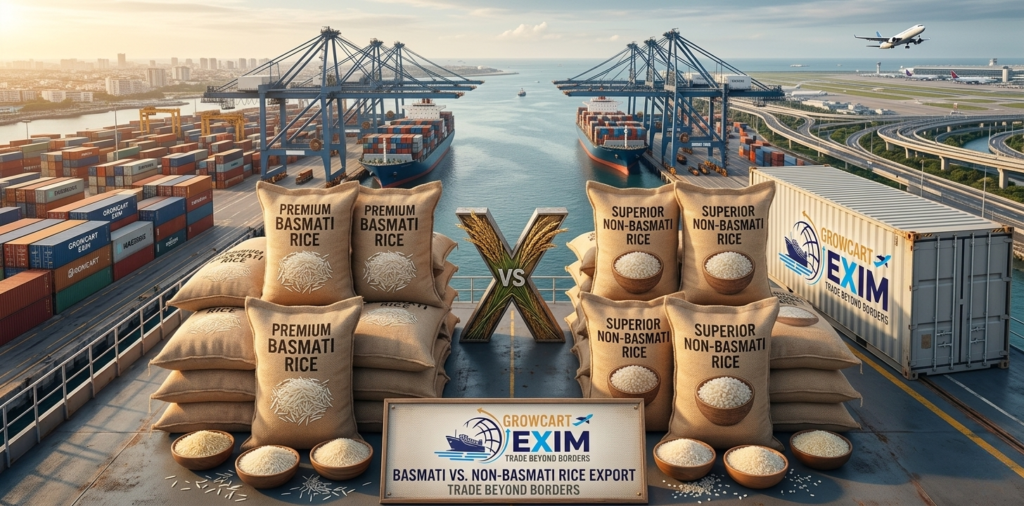
Many new exporters confuse the two. Here is the SEO comparison table for clarity.
| Feature | Basmati Rice | Non-Basmati Rice |
| Average Price | $900–$1,500/MT | $350–$600/MT |
| Export Regulations | Strict (GI tag, APEDA) | Moderate (FSSAI basic) |
| Top Market | Iran, Saudi Arabia | Bangladesh, Senegal, Benin |
| Profit per container | High ($4k+) | Low ($1k-$2k) |
| Demand Stability | Stable (Premium niche) | Volatile (Govt bans) |
FAQ:
We have optimized this FAQ section for voice search and featured snippets. Use natural language queries.
Q1: What is the procedure to start a basmati rice export business in India?
A: The procedure involves 5 steps: 1) Obtain an IEC Code from DGFT. 2) Register with APEDA. 3) Source GI-certified Basmati from approved mills. 4) Negotiate a Letter of Credit with a buyer in the Middle East rice market. 5) Ship via Mundra or Mumbai port with proper phytosanitary certification.
Q2: What is the profit margin on basmati rice export per ton?
A: The average net profit margin is 10% to 15% per metric ton for bulk traders. If you brand and package the rice yourself for retail (e.g., 5kg or 10kg bags), the margin can reach 25% to 30%.
Q3: Which country is the largest importer of Indian basmati rice?
A: Saudi Arabia is consistently the largest importer, followed by Iran and Iraq. In 2024-25, Saudi Arabia imported over 1.2 million metric tons of Indian basmati.
Q4: Do I need a license to export basmati rice from India?
A: Yes. You need a valid IEC Code from DGFT and an APEDA Registration number. You do not need a specific "rice export license" if you have these two, but you must adhere to the minimum export price (MEP) if imposed by the government.
Q5: What is the cost of exporting basmati rice in a 20ft container?
A: The cost ranges from $24,000 to $28,000 USD for a 26-metric-ton container, including FOB cost of rice, sea freight to the Middle East, insurance, and documentation fees.
Q6: How do I find basmati rice buyers worldwide?
A: Use B2B platforms like Alibaba (for smaller buyers), attend trade shows like Gulfood (Dubai), or hire a rice export consultancy. You can also request buyer lists from APEDA.
Regulatory Compliance & Entity SEO
You cannot ignore the legal framework. The DGFT (Directorate General of Foreign Trade) occasionally imposes a Minimum Export Price (MEP) to keep local prices stable.
- Current regulation (2025): No MEP on Basmati, but mandatory fumigation and Ozone Depleting Substances (ODS) compliance.
- International trade compliance: You must ensure your buyer’s country does not have an active anti-dumping duty on Indian rice.
Entity List for AI Crawlers:
- Government: DGFT, APEDA, FSSAI, Ministry of Commerce.
- Trade Terms: IEC Code, FOB (Free On Board), LC (Letter of Credit), Bill of Lading.
- Buyers: Almarai (Saudi), Olam International, LT Foods (Daawat).
Generative Engine Optimization (GEO) – How AI Tools Help
Google’s AI (Search Generative Experience) and ChatGPT citations favor structured data. Here is how AI tools scale this business:
- AI for Market Analysis: Use ChatGPT with plugins (e.g., WebPilot) to scrape daily rice prices in Rotterdam or Jebel Ali.
- Automated Documentation: Tools like ClearTax automate GST and IEC application forms.
- Logistics Optimization: AI platforms like Portcast predict freight rates and port congestion for rice export logistics and shipping.
- Content for Buyers: Use AI to generate personalized emails to basmati rice buyers worldwide based on their import history.
Conclusion:
You do not need a million dollars to start. You need a strategy.
Week 1-30: Get your IEC Code and APEDA Registration (Cost: ~$100 USD).
Week 30-60: Partner with a bonded warehouse near Mundra port. Source 1 container of 1121 Basmati.
Week 60-90: Use a trade facilitator or export market research for rice to find a mid-tier buyer in UAE rice import sector.



0 Comments